Training and Consultations
The Creative Advanced Machine Intelligence Research Centre (CAMIRC) offers specialized training and consultation services tailored to various industries and research needs. These include workshops on artificial intelligence, machine learning, and data analytics, as well as consultations for implementing AI-driven solutions in healthcare, education, and technology sectors. CAMIRC also provides guidance on integrating innovative technologies into business processes, fostering creativity, and addressing complex challenges through advanced machine intelligence. Their services aim to empower organizations and individuals with the knowledge and tools needed to thrive in a rapidly evolving technological landscape.
Fundamentals of Machine Learning in Cybersecurity
Overview
As cyber threats continue to grow in scale, sophistication, and frequency, traditional rule-based security systems are no longer sufficient. Machine learning (ML) offers powerful tools to detect, prevent, and respond to evolving cyberattacks. This training is designed to introduce participants to the foundational concepts of machine learning and its practical applications in cybersecurity. Participants will explore how ML models can be used to detect intrusions, classify malware, and identify anomalies in large-scale network and system logs. Through interactive lectures, case studies, and live demonstrations, learners will gain hands-on experience with key algorithms such as decision trees, SVM, and unsupervised clustering, and understand how these models are evaluated and deployed in real-world cybersecurity environments. By the end of the session, attendees will be equipped with the essential knowledge to begin integrating ML into cybersecurity workflows or research.
Learning Outcome: By the end of this training, participants will be able to:
Understand Core Concepts of ML and Cybersecurity
Apply ML Techniques to Cybersecurity Problems
Build and Evaluate ML Models
Interpret and Mitigate Model Risks
Explore Real-World and Emerging Applications
Duration: 1 Day

Training Programs
Fundamentals of Machine Learning in Healthcare
Overview
This 3-day training program introduces healthcare professionals, data scientists, and researchers to the foundational principles and applications of machine learning (ML) in the healthcare domain. Participants will explore how ML is revolutionizing medical diagnostics, patient care, clinical decision support, and healthcare operations. Through a combination of lectures, real-world case studies, and hands-on activities, the course provides a comprehensive overview of supervised and unsupervised learning techniques, model evaluation, and deployment strategies within clinical environments. By the end of the training, participants will be equipped with practical skills to begin implementing ML solutions in their healthcare institutions.
Learning Outcome: By the end of this training, participants will be able to:
Understand core machine learning concepts
Identify appropriate ML algorithms
Preprocess and analyze healthcare datasets
Develop and evaluate ML models
Interpret model results and visualizations
Understand ethical, regulatory, and privacy considerations
Explore real-world case studies
Deploy ML models in healthcare settings
Duration: 3 Days
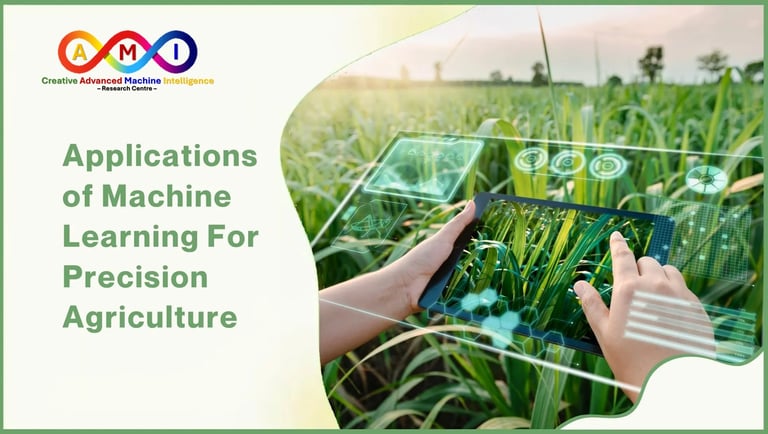
Fundamentals of Machine Learning in Smart and Precision Farming
Overview
This 3-day intensive training on Fundamentals of Machine Learning in Smart and Precision Agriculture is designed to equip participants with practical knowledge and foundational skills in applying machine learning (ML) to modern, data-driven farming practices. With agriculture increasingly shaped by digital transformation, ML offers powerful tools to optimize crop production, enhance sustainability, and support real-time decision-making. Participants will explore how ML can be applied to solve challenges in precision irrigation, crop health monitoring, yield prediction, soil analysis, and pest/disease detection. The course integrates technical lectures, real-world case studies, and hands-on sessions using real agricultural datasets (e.g., drone imagery, sensor data, weather patterns). By the end of the training, participants will be capable of developing, evaluating, and proposing AI-driven solutions tailored for smart farming systems.
Learning Outcome: By the end of this training, participants will be able to:
Explain the core principles of machine learning and its relevance to smart and precision agriculture.
Identify various types of agricultural data (e.g., weather, soil, crop, UAV imagery, IoT sensors) and understand how to preprocess and clean them for ML applications.
Apply supervised and unsupervised ML algorithms to real agricultural problems such as crop yield forecasting, disease detection, and farm zoning.
Perform feature extraction and engineering for spatial-temporal agricultural datasets to support accurate predictions and interventions.
Evaluate ML model performance using metrics relevant to agricultural outcomes, such as RMSE, MAE, Precision, and Recall.
Design and prototype ML-powered smart farming solutions, such as AI-driven irrigation systems, pest alert systems, or decision-support dashboards.
Understand practical deployment strategies, including edge computing, integration with farm management systems, and real-time decision automation.
Address ethical, environmental, and data privacy considerations in deploying ML solutions in precision agriculture.
Duration: 3 Days
Fundamentals of Machine Learning for SMEs
Overview
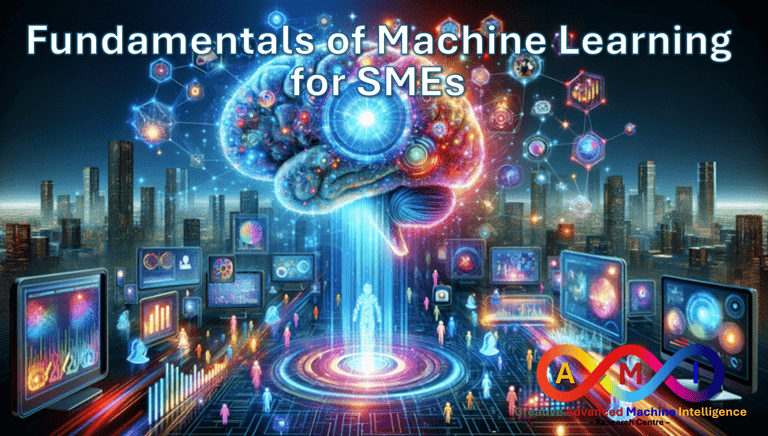
This 3-day training program is designed to introduce Small and Medium Enterprise (SME) owners, managers, analysts, and technical staff to the fundamentals of machine learning (ML) and its transformative role in business operations. As SMEs navigate digitalization, ML offers powerful tools to improve decision-making, automate workflows, enhance customer experiences, and optimize sales, logistics, and marketing. The training provides a practical, business-focused understanding of ML concepts and tools, emphasizing real-world SME applications such as sales forecasting, customer segmentation, inventory optimization, and fraud detection. Through a combination of lectures, interactive discussions, and hands-on sessions using sample datasets, participants will learn how to plan, evaluate, and deploy simple ML solutions tailored to their business challenges.
Learning Outcome: By the end of this training, participants will be able to:
Understand the fundamentals of machine learning and how they apply to business operations in SMEs.
Identify high-impact ML use cases in SMEs, including customer profiling, sales forecasting, marketing personalization, and process automation.
Prepare and clean business data (sales, inventory, customer behavior, transactions) for ML analysis.
Apply common ML techniques such as classification, regression, and clustering to SME-relevant scenarios.
Interpret model performance metrics like accuracy, precision, recall, and RMSE in the context of business outcomes.
Develop simple ML prototypes using open-source tools or platforms suited for SMEs (e.g., Python, Orange, Google AutoML).
Plan for ML integration into existing SME workflows and digital tools, such as CRM, accounting, or POS systems
Understand the risks, limitations, and ethical considerations of applying ML in small business environments, including data privacy and bias.
Duration: 3 Days
Innovative AI Solutions
Exploring creative applications of AI to enhance industries through advanced machine intelligence and research.
Creative AI Art
Developing AI-generated art, music, and writing to inspire creativity and innovation across various fields.


AI Problem Solving
Conducting research on AI's potential to address complex challenges in healthcare, education, and technology sectors.
Partnering with organizations to advance AI capabilities while addressing ethical and social implications of technology.
Collaborative AI Research


